
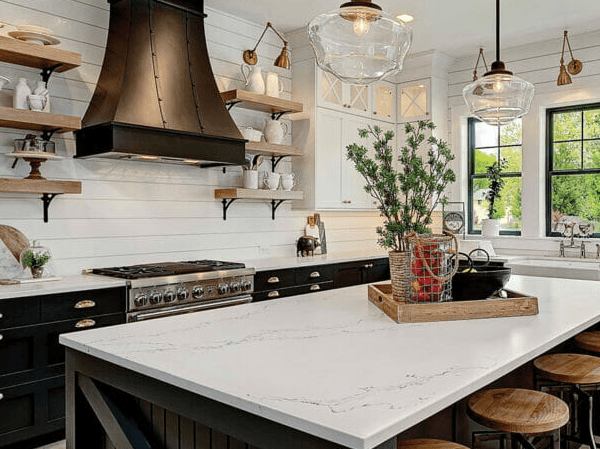
Granite vs. Quartz Countertops
Granite vs. Quartz Countertops: Which Is Right for Your Kitchen?
Published by LIVA Kitchen & Bath | Chantilly, VA
It’s the question we get more than any other at LIVA Kitchen & Bath: “Should I go with granite or quartz?”
Both are excellent materials. Both are durable, beautiful, and add real value to your home. But they’re not the same, and the right choice depends on how you cook, how you clean, and what look you’re after.
We’ve installed thousands of countertops across Washington D.C., Maryland, and Virginia. Here’s our honest, side-by-side breakdown — no sales pitch, just the facts.
What Exactly Are They?
Granite is a 100% natural stone quarried from the earth. It’s formed over millions of years from cooled magma, which is why every slab has a completely unique pattern of colors and minerals. When you choose granite, you’re getting something that exists nowhere else in the world.
Quartz countertops (sometimes called engineered stone) are manufactured. They’re made from about 90–95% crushed natural quartz crystals mixed with polymer resins and pigments. The result is a surface that’s consistent, non-porous right out of the factory, and available in a much wider range of colors and patterns — including designs that mimic marble or other stones.
Appearance: Natural Character vs. Consistent Design
This is often the deciding factor for homeowners.
Granite offers depth and movement that manufactured materials simply can’t replicate. The way light plays through a slab of Absolute Black or Blue Pearl granite is something you have to see in person. The variation also means your countertop will be unique — no two kitchens will ever look exactly alike.
The flip side: what you see in the sample tile at the showroom is not exactly what you’ll get. The full slab will have more variation, more character. Some people love this. Others find it unpredictable.
Quartz is what you see is what you get. The pattern you choose in the showroom is essentially identical to what will be installed in your kitchen. This makes it much easier to plan around — especially if you’re coordinating with specific cabinet colors, tile, or flooring.
Quartz also excels at mimicking other stones. Modern quartz products can look remarkably close to Carrara marble without any of marble’s maintenance requirements. If you love the white-and-gray marble aesthetic but want a more practical surface, quartz is often the answer.
Winner for design flexibility: Quartz Winner for natural beauty and uniqueness: Granite
Durability: Both Are Excellent, With Key Differences
Hardness and scratching
Granite is extremely hard — it rates 6–7 on the Mohs hardness scale. It resists scratching from knives and kitchen utensils very well, though we still recommend always using a cutting board (it’ll dull your knives faster than it damages the granite).
Quartz is similarly hard and actually slightly more uniform in its hardness because it’s engineered. It’s also very scratch-resistant under normal kitchen use.
Heat resistance
Granite handles heat very well. You can generally set a hot pan on granite without damage, though sudden thermal shock from extreme temperatures can theoretically cause cracking over years of abuse.
Quartz is more heat-sensitive. The resin binders in quartz can discolor or crack under sustained high heat. Always use trivets with quartz — this is a firm rule, not just a suggestion.
Chipping and cracking
Both materials can chip at the edges if subjected to hard impacts. Quartz, because of its uniform composition, tends to be slightly more resilient against edge chipping. Granite can have natural fissures that, while not structural weaknesses, can become chip points over time.
Winner for heat resistance: Granite Winner for overall impact resilience: Quartz (slight edge)
Maintenance: The Biggest Practical Difference
This is where quartz pulls ahead significantly for busy households.
Granite maintenance
Granite is porous and must be sealed to prevent staining. A quality sealant will protect it well, but sealing needs to be repeated — typically every 1–3 years depending on the stone and your usage. Unsealed or poorly sealed granite can absorb oil, wine, and other liquids, leaving permanent stains.
Day-to-day cleaning is simple: warm water and a mild soap or pH-neutral stone cleaner. But you do need to be mindful of what you use — harsh chemicals and acids can damage the sealant.
Quartz maintenance
Quartz is non-porous by design. It never needs sealing. You can clean it with mild soap and water, and it resists staining much better than granite — including from wine, coffee, and cooking oils.
The one caveat: the resin in quartz can be damaged by strong chemicals (bleach, oven cleaners, paint thinner). Stick to gentle cleaners.
Winner for low-maintenance living: Quartz — and it’s not close.
Cost: Closer Than You Might Expect
Historically, granite was seen as more affordable and quartz as the premium option. That gap has narrowed considerably.
In the DMV market (DC, Maryland, Northern Virginia), you can expect:
- Entry-level granite: Starting around $40–$60 per square foot installed
- Mid-range granite: $60–$100 per square foot installed
- Premium exotic granite: $100–$200+ per square foot installed
- Entry-level quartz: Starting around $50–$75 per square foot installed
- Mid-range quartz (Cambria, Caesarstone): $75–$120 per square foot installed
- Premium quartz: $120–$200+ per square foot installed
The real cost comparison should factor in long-term maintenance. Granite requires periodic sealing (a cost of time or money), while quartz does not. For most kitchen sizes, the sealing cost over 10 years adds up to a few hundred dollars — not a huge factor, but worth knowing.
At LIVA Kitchen & Bath, we offer competitive pricing on both materials and are happy to give you a free quote for your specific project.
Which Is Better for Kitchens vs. Bathrooms?
Kitchen countertops: Both work extremely well. If you cook frequently and are less diligent about maintenance, quartz is more forgiving. If you love the look of natural stone and don’t mind the occasional sealing, granite is beautiful and durable.
Bathroom vanities: Quartz is often the better choice here — bathrooms see frequent water exposure, soap, and cosmetic products. The non-porous nature of quartz handles all of this better than granite.
Outdoor kitchens: Granite is the better choice. UV rays from sunlight can fade and damage quartz’s resin over time, while granite is unaffected.
The Honest Summary
| Granite | Quartz | |
|---|---|---|
| Natural material | ✓ Yes | ✗ No (engineered) |
| Unique appearance | ✓ Every slab unique | Consistent, predictable |
| Heat resistance | ✓ Excellent | Fair (use trivets) |
| Stain resistance | Good (when sealed) | ✓ Excellent |
| Requires sealing | Yes (every 1–3 years) | ✓ Never |
| Color options | Limited to natural stone | ✓ Virtually unlimited |
| Price range | $40–$200+ per sq ft | $50–$200+ per sq ft |
| Best for | Natural beauty lovers, outdoor use | Busy families, bathrooms, modern designs |
Still Not Sure? Come See Both in Person
Reading about stone is one thing — holding a sample in your hands and seeing it in your own space is another. At LIVA Kitchen & Bath, we offer free design consultations where you can see actual slabs from our collection of 2,000+ colors in both granite and quartz.
We serve Washington D.C., Maryland, and Northern Virginia, with a 3-day turnaround from measurement to installation — the fastest in the region.
Call us at (703) 898-6479 or contact us online to schedule your free consultation.
LIVA Kitchen & Bath | 14805-G Willard Rd, Chantilly, VA 20151 | (703) 898-6479 | info@livakitchenbath.com